CerealKiller's Dark War Survival

Troop Strategy — Concentrate or Spread?

The game gives you three factions and expects you to build all of them. The combat reports tell a different story. Your troops are the base that everything else multiplies — and concentration makes that base hit harder. Here's the case for single-faction investment, backed by real battle data from S497.
Your Troops Are the Weapon

Stat overview — CK 806% ATK vs Calderon 775%. CK 8,726 T9 vs Calderon 7,164 T10. CK won despite lower tier.
Calderon had T10, better gear — but fewer troops. CK won.

Before talking about which faction to build, there's a more fundamental insight from the battle systems page: troops are the base that everything else multiplies. Heroes, equipment, research, your vehicle — they're all multipliers. A bigger base with decent multipliers beats a smaller base with better multipliers.

The Calderon battle proves it: CK had T9, Calderon had T10 with better gear and a better vehicle. But CK had 22% more troops. CK won in 21 rounds. Troop count is the multiplier that most players undervalue.

The priority: Train more troops. Upgrade your Camp to unlock higher tiers. Fit more troops into each APC. Then concentrate your multipliers on one faction so they compound harder. That's the One Arm Warrior doctrine in two sentences.

CerealKiller's Approach — The One Arm Warrior

CK goes all-in on one faction (Fighters) until Watchtower 30. Fighter Camp, Fighter research (ATK, DEF, HP), Fighter heroes, Fighter gear — everything. Only touch Shooter or Rider buildings and research when they're literal prerequisites blocking the Watchtower upgrade path. After Watchtower 30, begin diversifying. This is one expression of a broader principle: in a multiplicative system, depth beats breadth. The same logic applies to any single faction you choose to concentrate on.

The Case for Concentration

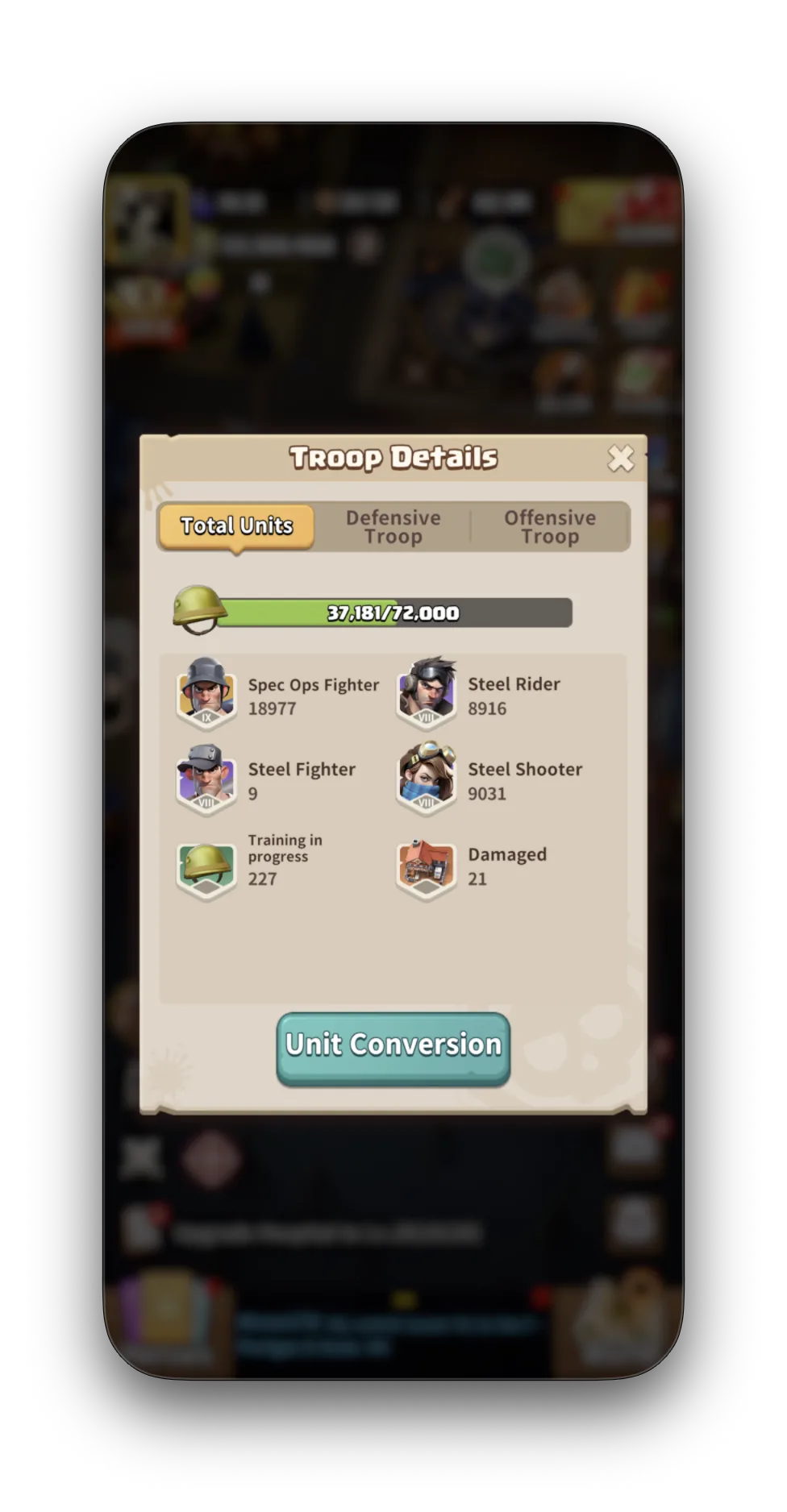
CerealKiller's troop breakdown — Spec Ops Fighters dominating
CK's troops — 18,977 Spec Ops Fighters

Why the Math Favours Depth Over Breadth

The game's power scaling is multiplicative, not additive. When you concentrate investment in one faction, every layer compounds with every other:

Camp level × faction research (ATK/DEF/HP) × faction hero skills × faction gear × faction stacking bonus (3+ same-faction heroes = 15% ATK/DEF)

Splitting resources across three factions means each one sits at roughly one-third depth. But since the multipliers compound, you don't get one-third the power — you get dramatically less. In CK's case, a concentrated Tier 7 Fighter army outperforms a balanced army with T5 across all three factions by a wide margin. The same principle holds for Riders or Shooters — the math doesn't care which faction you concentrate on, only that you concentrate.

Troop Buffs — CK Faction Bonus 71.2% vs NKS 20.3%. CK 829.5% Total ATK vs NKS 426.1%. The concentration advantage is visible in every line.
CK's Faction Bonus: 71.2% vs NKS 20.3% — concentration in action. Full breakdown →

Why CerealKiller Chose Fighter

Every faction has its own multiplicative core — a set of heroes with army-wide passives that compound, a research tree that rewards depth, and accessible S-tier heroes. The principle of concentration applies to all of them. Here's why CK specifically chose Fighter:

CK's reasoning

Guy is the most accessible S-rank hero. Fighter faction, available early. Building Fighter troops gives Guy bonus damage and defence, plus 5% extra troop capacity.

CK's reasoning

Catherine Rex is free via story progression. Second S-tier, also Fighter. Two S-rank Fighter heroes without spending — that's a multiplicative head start most factions can't match at this stage.

CK's reasoning

Francis fills the third slot for the 15% faction bonus. Fighter/Tank with the best HP passives. Three Fighter heroes = 15% faction ATK/DEF bonus activated.

The principle

One deep research tree outperforms three shallow ones. This is true for any faction. HP research scales harder than ATK or DEF. The key decision isn't "which faction" — it's "will I commit to one?"

The "Glass Cannon" Myth

Single-faction isn't glass cannon. You're not skipping durability — you're skipping breadth. Fighter research trees include DEF and HP nodes. What you're vulnerable to is the faction triangle — Riders counter Fighters. But pre-WT30, a maxed Fighter formation beats a spread-thin Rider army on raw stats alone.

What to Build — The Priority Order

1
Fighter Camp — Max it first Unlocks higher tiers, massive stat increase
2
Fighter Research — ATK → Damage → DEF → HP Two offensive multipliers compound harder than one. See exception below for when your heroes change this order.
3
Efficient Training tech 200%+ speed boost before mass-training
4
Promote, don't retrain Promoting costs same, processes faster

Exception — When Hero Passives Change the Order

The default ATK → HP → DEF assumes your research is carrying the full survivability load. But if your hero roster includes strong faction-wide DEF and HP passives — like Tristan (+30% all Fighters' DEF) and Francis (+14.5% all Fighters' HP) — your heroes are already delivering 49% more effective survivability before a single research node.

In that case, shift research to offence: ATK → Damage → DEF → HP. Your heroes handle defence; research handles attack. ATK and Damage are separate multipliers in the combat formula — they multiply each other, not add. So 20% more ATK × 20% more Damage = 44% more output, versus stacking one stat for only 40%. Two offensive multipliers beat one.

DEF still ranks above HP because Tristan's 30% is the larger passive — DEF research compounds on a bigger hero-given base. HP last because Francis's 14.5% is the smaller boost, and in most combat calculations, reducing incoming damage (DEF) is worth more than absorbing it (HP).

The principle: don't duplicate what your heroes already provide. Let passives handle survivability, use research to fill the gap they leave — offence.

Troop Details — Total Units showing 18,977 Spec Ops Fighters, 9 Steel Fighter, 9,116 Steel Rider, 9,031 Steel Shooter. OAW doctrine in action.
CK's troop makeup — OAW in action

What About Your Other Factions?

If you're running a concentration strategy, your non-primary factions serve a support role pre-WT30:

The trade-off

Every resource spent on a second faction's combat capability dilutes your primary faction's multiplicative stack. Pre-WT30, that dilution costs more than the breadth gains.

The trade-off

Researching a second faction's tree means your primary tree stays shallower for longer. In a multiplicative system, that's a compounding loss.

CK's approach

Build Shooter and Rider camps only when they're literal prerequisites for Watchtower upgrades. Make the minimum investment to unblock, then stop.

CK's approach

Use T1 filler troops for gathering (formations 3 and 4). They're cheap, don't need research, and free your primary troops for combat.

When Does It Make Sense to Diversify?

Most guides say WT30 is when you diversify. The reasoning is sound: diminishing returns on deep faction research, alliance wars that demand multiple formation types, and PvP opponents who exploit faction counters. All real factors.

But "diversify" doesn't mean "balance." In CK's experience, it means expand — slowly, deliberately, and only with troops and research. Hero investment and real-money spending tend to compound deepest when they stay concentrated on one faction, even post-30.

Why? The Dollar Cost of a Second Faction

Building a competitive second faction means duplicating what took months to build: a new multiplicative hero pair (DEF + HP passives), exclusive weapons, deep research tree, high-tier troops. Every faction has its own Tristan-equivalent and Francis-equivalent — the game designs it this way deliberately. Three factions × hero fragments × exclusive weapons × research = triple the spending.

For whales, that's fine — if money isn't the constraint, balanced works. But for C2P players spending less than US$10/day, a second faction's hero build is effectively starting over. Your dollars compound deepest when they compound in one place.

DO POST-30

Diversify troops and research. Train second-faction troops using free resources. Open a Shooter or Rider research tree when Fighter nodes get prohibitively expensive. This costs time, not money.

DON'T POST-30

Don't diversify hero spending. Fragments, exclusive weapons, and real-money hero packs still go to your primary faction. A deep primary + shallow secondary beats two medium factions every time.

The Monetisation Pattern

The game gives every faction its own multiplicative pair, its own exclusive weapons, and its own research tree — because the game wants you to build all three. It's the same design principle as countdown timers and FOMO events: create a rational-feeling reason to spend more. "Balanced is better" sounds like strategy advice. It's actually the most expensive path in the game. Concentration is the counter — at every Watchtower level.

THE ALLIANCE ARGUMENT

Pre-30, alliance diversity comes from member specialization — you're the Fighter player, someone else is the Rider player. Post-30, alliance wars still benefit from this. You don't need to be a generalist if your alliance coordinates. Stay deep, let your alliance be wide.

Formation Structure

Spec Ops Fighter training in progress — Fighter Camp active
Spec Ops Fighter training — Fighter Camp
Formation Purpose Composition
Formation 1 Primary combat Highest-tier Fighters + Guy, Catherine Rex, Francis (15% faction bonus)
Formation 2 Secondary combat Next-best Fighters + Liz, Scarlet
Formation 3 Gathering only T1 disposable + gathering heroes
Formation 4 Gathering only T1 disposable + resource bonus heroes
DO

Train with discipline. Batch training into Formation 1 first, then cascade overflow to Formation 2. Never scatter troops across all four formations.

DO

Prioritize training speed. Use Efficient Training tech and resources to accelerate. Time saved = more resource nodes cleared = earlier WT30.

Troop Tier Stats T1–T10

Spec Ops Fighter (T9) — Attack 44, Defense 44, HP 132, Speed 10, Load 2200, CP 1780
T9 Spec Ops Fighter — the base stats everything multiplies

All factions have identical base stats. These are the numbers your buffs multiply — this is why troop tier matters so much. A T9's ATK 44 multiplied by 800% in buffs hits very differently than a T6's ATK 20.

Tier ATK DEF HP Speed Load CP
T1774910600150
T2995410800220
T3121260101000310
T4171768101200450
T5222277101400660
T6272786101600850
T73232961018001070
T837371111020001380
T944441321022001780
T1051511531024002190

Key observation: T1→T10 ATK jumps 7→51 (7.3x), HP 49→153 (3.1x). Attack scales faster than survivability.

Watchtower → Troop Tier Unlock Map

WT Level Camp Unlock Troop Tier Key Milestone
1–3Camp Lv 1–3T1Tutorial phase
4–6Camp Lv 4–6T2WT6: Hero level cap lifted past 10
7–9Camp Lv 7–9T3WT7: World map + Radar unlock
10–12Camp Lv 10–12T4WT10: Research Centre Lv1 required
13–15Camp Lv 13–15T5WT14: Electricity resource begins
16–18Camp Lv 16–18T6Resource costs escalate sharply
19–21Camp Lv 19–21T7Build times exceed 10 days
22–24Camp Lv 22–24T8WT requirements rotate across all 3 camps
25–27Camp Lv 25–27T9Build times exceed 25 days
28–30Camp Lv 28–30T10WT30: Industrial Age unlocks

UNVERIFIED WT STAT BONUS

Some players report a hidden stat bonus applied at certain WT thresholds. Not confirmed in-game. Plan defensively and assume no bonus.

OAW vs Balanced Calculator

See the multiplicative difference for yourself. Set the same total troop count and tier, but compare what happens when all troops are in one faction (with deep research and the faction bonus) versus split evenly across three factions (with shallower research, since resources were divided).

ONE ARM WARRIOR

Total ATK
0
Total DEF
0
Total HP
0
Total CP
0

BALANCED BUILD

Total ATK
0
Total DEF
0
Total HP
0
Total CP
0

Honest Assessment — Who This Isn't For

NOT FOR

Heavy spenders ($50+/day). Speed-farming resources with premium eliminates the constraint OAW optimizes for.

NOT FOR

Alliance Leaders (R4/R5). You need balanced troops for core team operations and rally diversity.

NOT FOR

Arena/Duel competitors. Single-faction is predictable. You'll lose to counter-drafted teams.

NOT FOR

Late joiners. If the server is past WT30 globally, the balance-first meta is already established.

Weaknesses You'll Feel

WEAKNESS

Formation 2 is a liability. Without second-rank heroes and research, it folds fast to organised attacks.

WEAKNESS

Healing costs after a loss are maximum. You're treating your troops as disposable. Expect to rebuild frequently.

WEAKNESS

The WT forces diversification anyway. By WT30, you'll need Shooters and Riders built. You're just delaying, not avoiding.

WEAKNESS

Monotony is a real risk. Playing one faction for 6+ months is tedious. Some players quit before WT30.

When Does This Approach Work Best?

The One Arm Warrior is most effective for C2P and F2P players who are patient, play within an active alliance, and accept short-term PvP vulnerability in exchange for long-term compounding. If those conditions match your situation, single-faction concentration will likely get you to WT30 with significantly more usable power than a balanced approach at the same level. But it's a commitment — and the weaknesses above are real. Choose the approach that fits how you actually play, not just what optimises on paper.