Team Composition

Hero Guide — Which Heroes Are Actually Worth Building?

Everyone has a tier list. Here's a more useful question: which heroes multiply your entire army, not just themselves? This guide explains the principle of multiplicative passive stacking — and how to apply it regardless of which faction you're building.

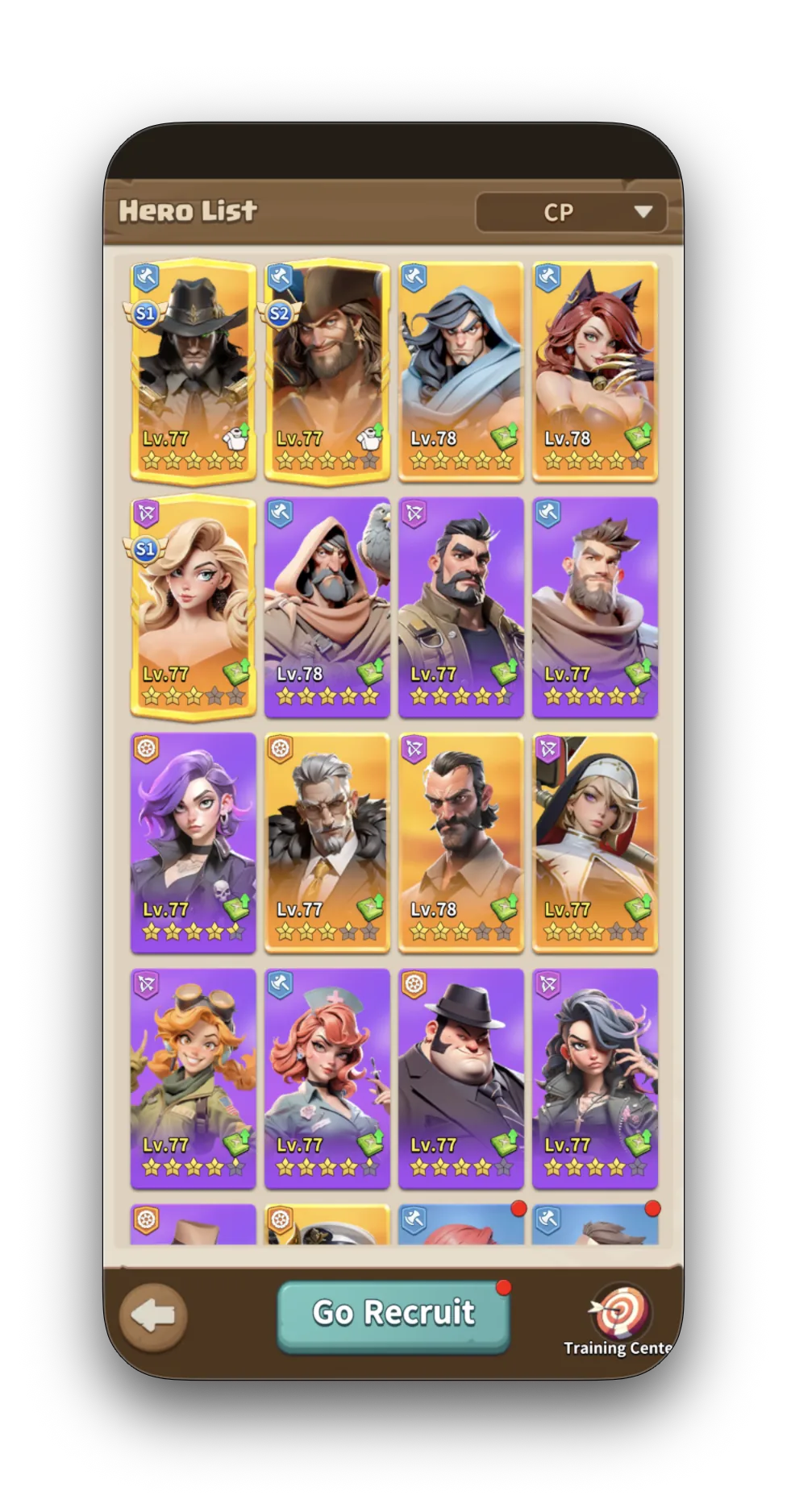
CerealKiller's hero roster page 1 — sorted by CP
CK's roster — S497, Mar 2026

The Question That Changes How You Pick Heroes

Every hero has a passive skill that buffs something — troop DEF, troop HP, troop ATK, faction damage. Most players pick heroes by individual CP or tier list rankings. Those matter, but there's a more powerful lens to apply first.

Ask: what does this hero's passive do to my entire army? A hero with +30% faction DEF doesn't just make themselves tougher — they make every troop in your army tougher. Now pair that hero with one who gives +14.5% faction HP. Those two passives don't add together. They multiply. This is the principle of multiplicative passive stacking, and it applies to every faction in the game.

The Stacking Formula

One hero gives +30% DEF (your troops take less damage per hit). Another gives +14.5% HP (your troops survive more hits). Together: 1.30 × 1.145 = 1.49 — a 49% increase in effective survivability. That's nearly half again as tough as having neither. No single hero provides that kind of army-wide boost alone. This is the core principle: find your faction's multiplicative pair.

This principle applies to every faction. Fighters, Riders, and Shooters each have heroes with army-wide passives that stack. The specific heroes differ, but the math works the same way. Find the DEF booster and the HP booster for your chosen faction — then build around them.

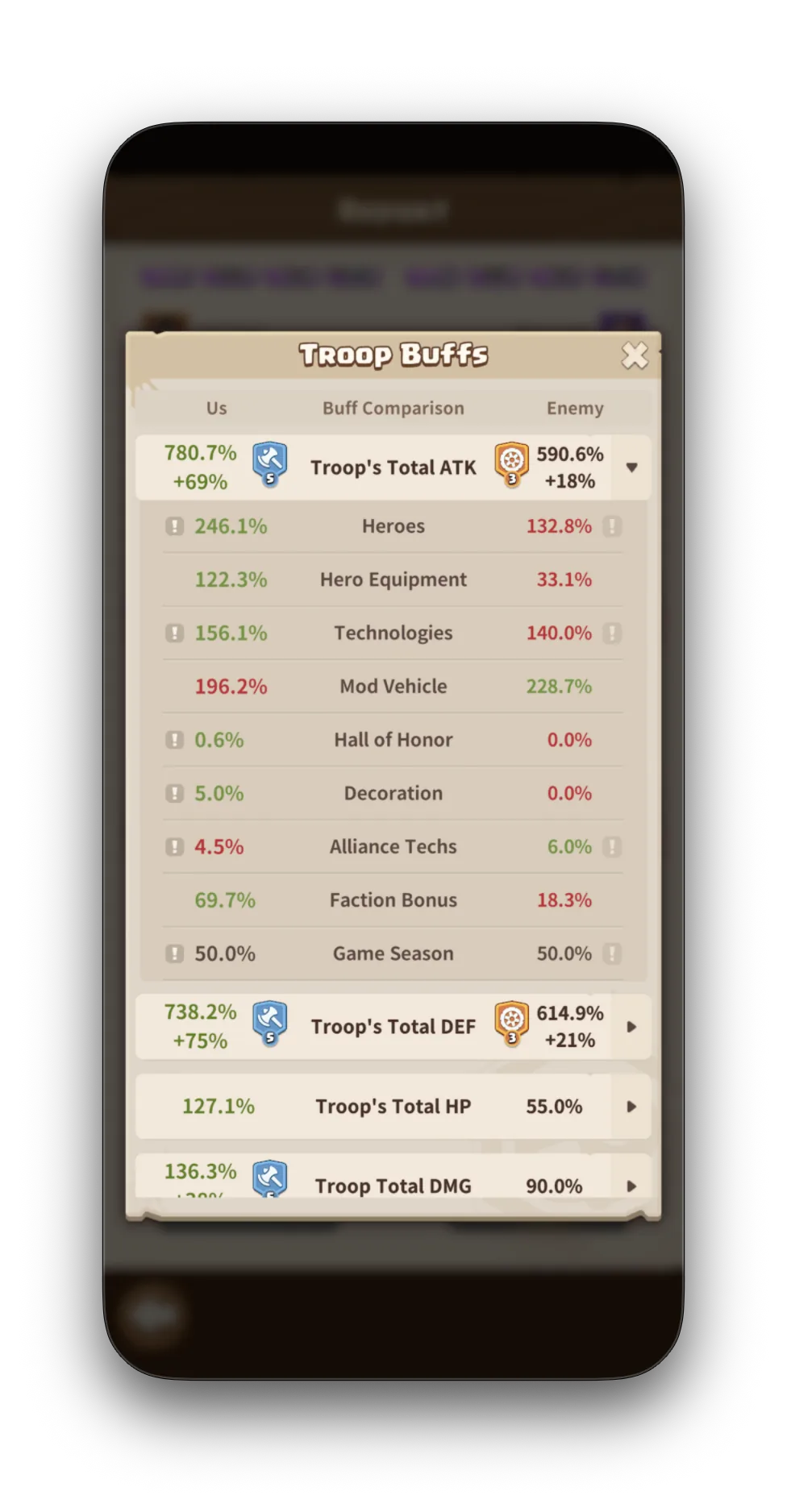
The combat reports prove it. In the battle systems page, the Troop Buffs section shows "Heroes" as a single pooled percentage — CK's 246.1% vs Dinhthai's 132.8%. That's the combined effect of all hero passives stacking together. The 113% gap is where multiplicative hero selection creates real battlefield advantage.

Troop Buffs ATK — Heroes 246.1% vs 132.8%. Hero Equipment 122.3% vs 33.1%. The multiplicative stack in real battle data.
Heroes: 246.1% vs 132.8% — the passive stacking advantage in real data

Fighter Example — How CerealKiller Built It

Here's how this principle plays out in practice. CerealKiller runs a Fighter-faction army on S497. The multiplicative core:

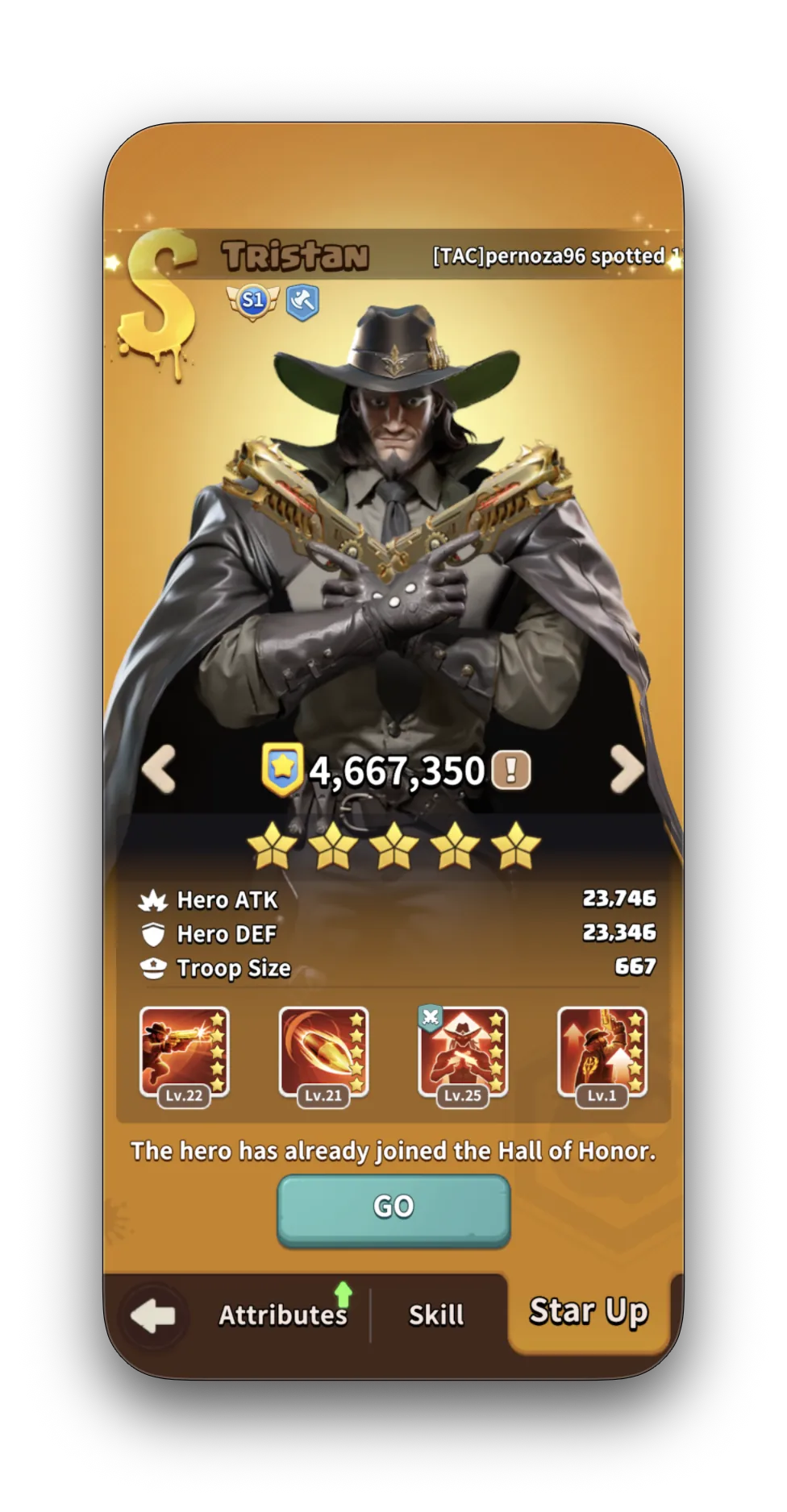
Tristan — S-tier Fighter, 5 stars, CP 4,667,350, ATK 23,746 / DEF 23,346 / Troop 667
Tristan — 5★, CP 4.67M
T

Tristan — The DEF Multiplier Core

Fighter / DPS — CP 4,667,350 · ATK 23,746 · DEF 23,346 · Troop 667

Passive "Training Expert: Assaulter" boosts all Fighters' DEF by up to 30%. He's also the highest CP hero in the roster with balanced ATK/DEF — unusual for DPS. His "Rain Fire" active deals 2,668% at Lv.22. But the real value is that passive — it's working on every Fighter troop in every battle, silently.

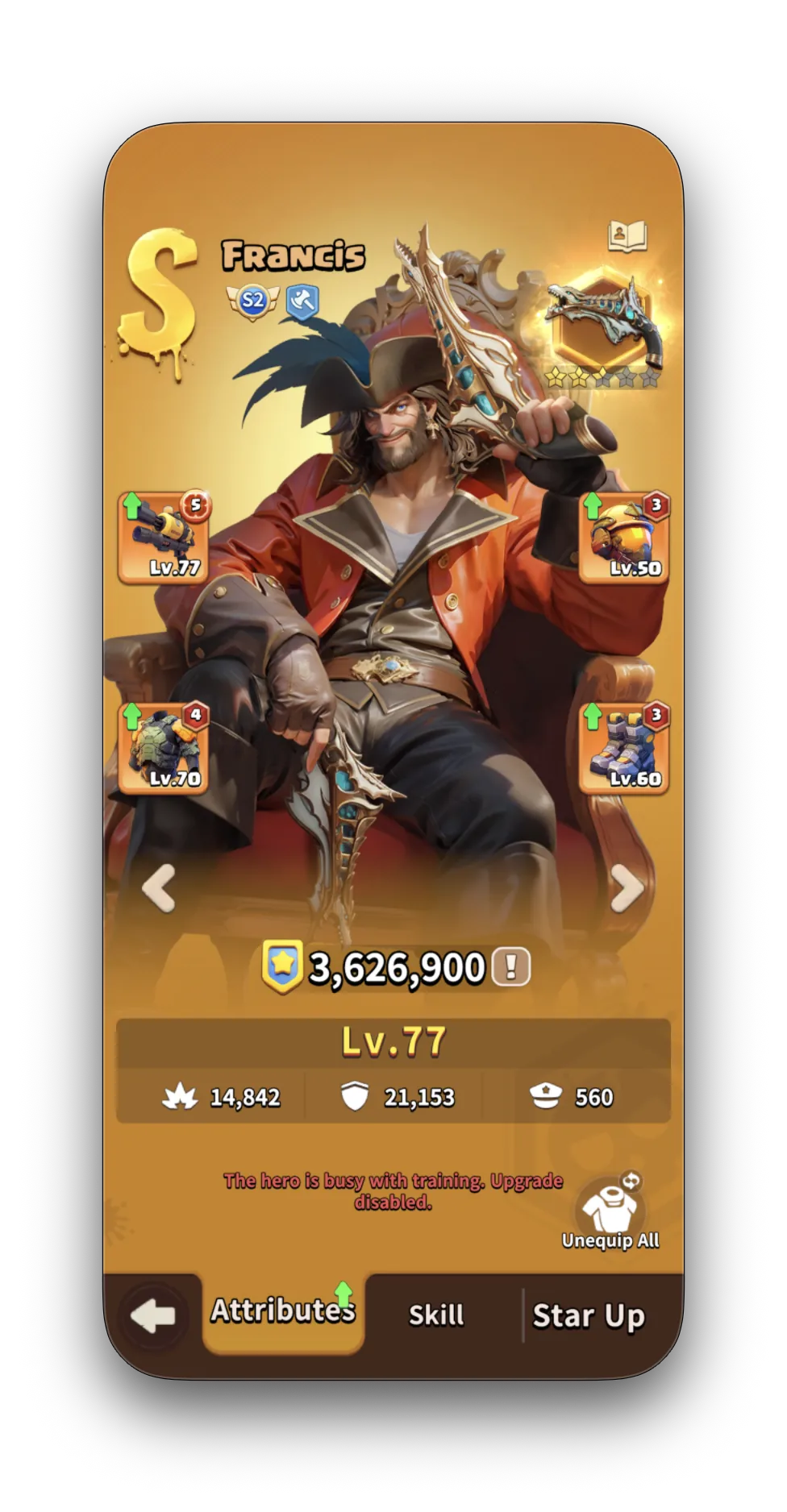
Francis — S-tier Fighter, Lv.77, CP 3,626,900, DEF 21,153
Francis — Lv.77, DEF 21,153
F

Francis — The HP Multiplier Core

Fighter / Tank — CP 3,626,900 · ATK 14,842 · DEF 21,153 · Troop 560

Passive "Heart of Steel" boosts all Fighters' HP by 14.5%. Highest DEF in the roster at 21,153 — a natural wall. His "Fire Barrage" active still deals 1,719% damage. Exclusive Equipment "Siren's Blessing" adds Faction Counter +4.60%, yet another multiplicative layer. Tank that hits hard and makes your entire army harder to kill.

Together: Tristan's +30% DEF × Francis's +14.5% HP = 49% more effective survivability for every Fighter troop. And since 4 out of 5 heroes in the squad are Fighters, this passive stacking covers almost the entire army.

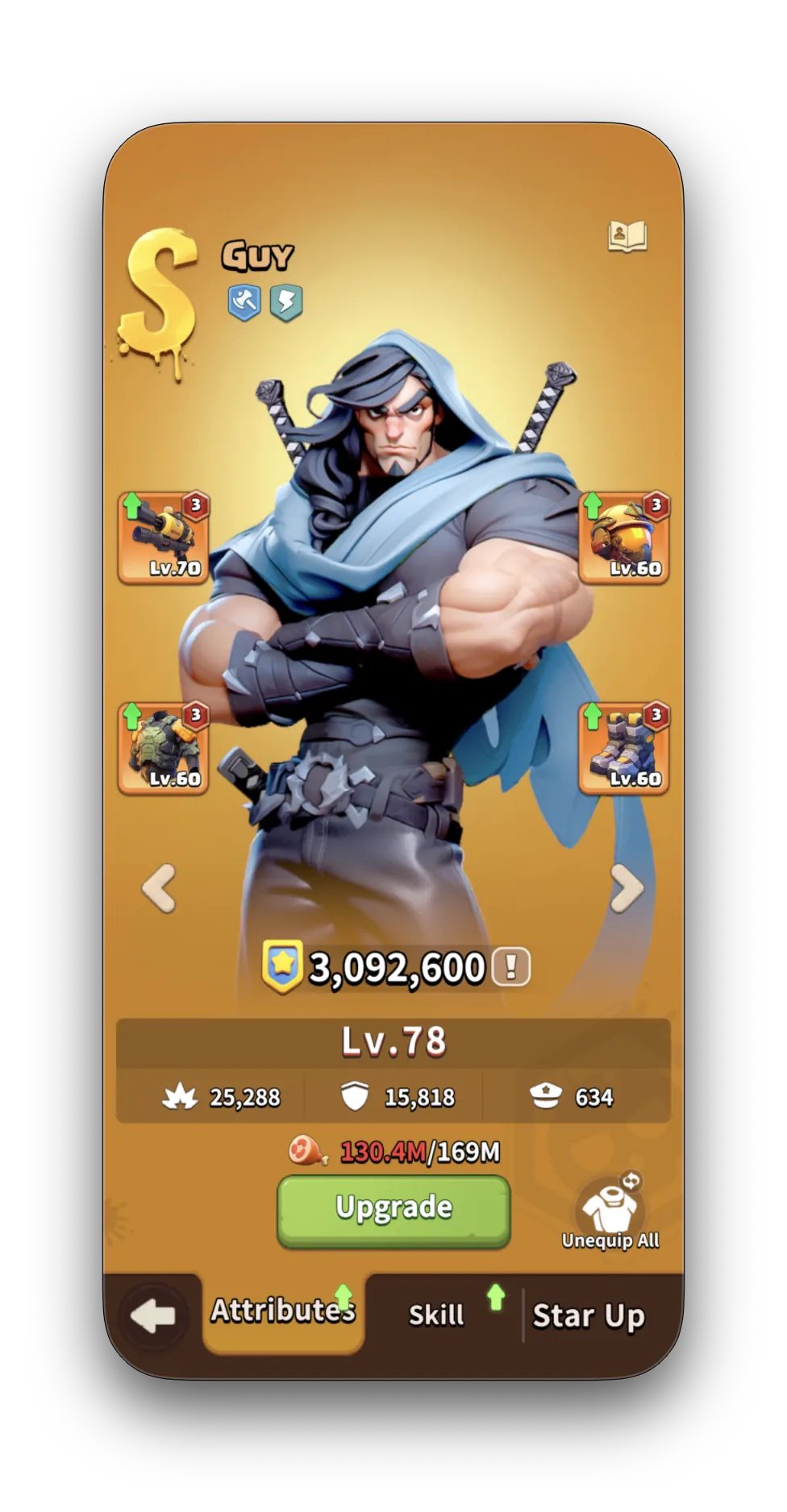
Guy — S-tier Fighter, Lv.78, CP 3,092,600, ATK 25,288
Guy — Lv.78, ATK 25,288

Supporting Cast — Filling the Gaps

With the multiplicative core established, remaining slots fill specific roles. Each hero adds something the core pair doesn't cover.

G

Guy — Primary Striker DPS

Fighter / DPS — CP 3,092,600 · ATK 25,288 · DEF 15,818 · Troop 634

Highest raw ATK in the roster. "Blade Storm" deals 2,586% at Lv.20. While Tristan and Francis make the army survive, Guy is the one dealing killing blows. Progression skill "Samurai's Gift" boosts idle food gains — rare dual combat + economy value. Equip with ATK gear.

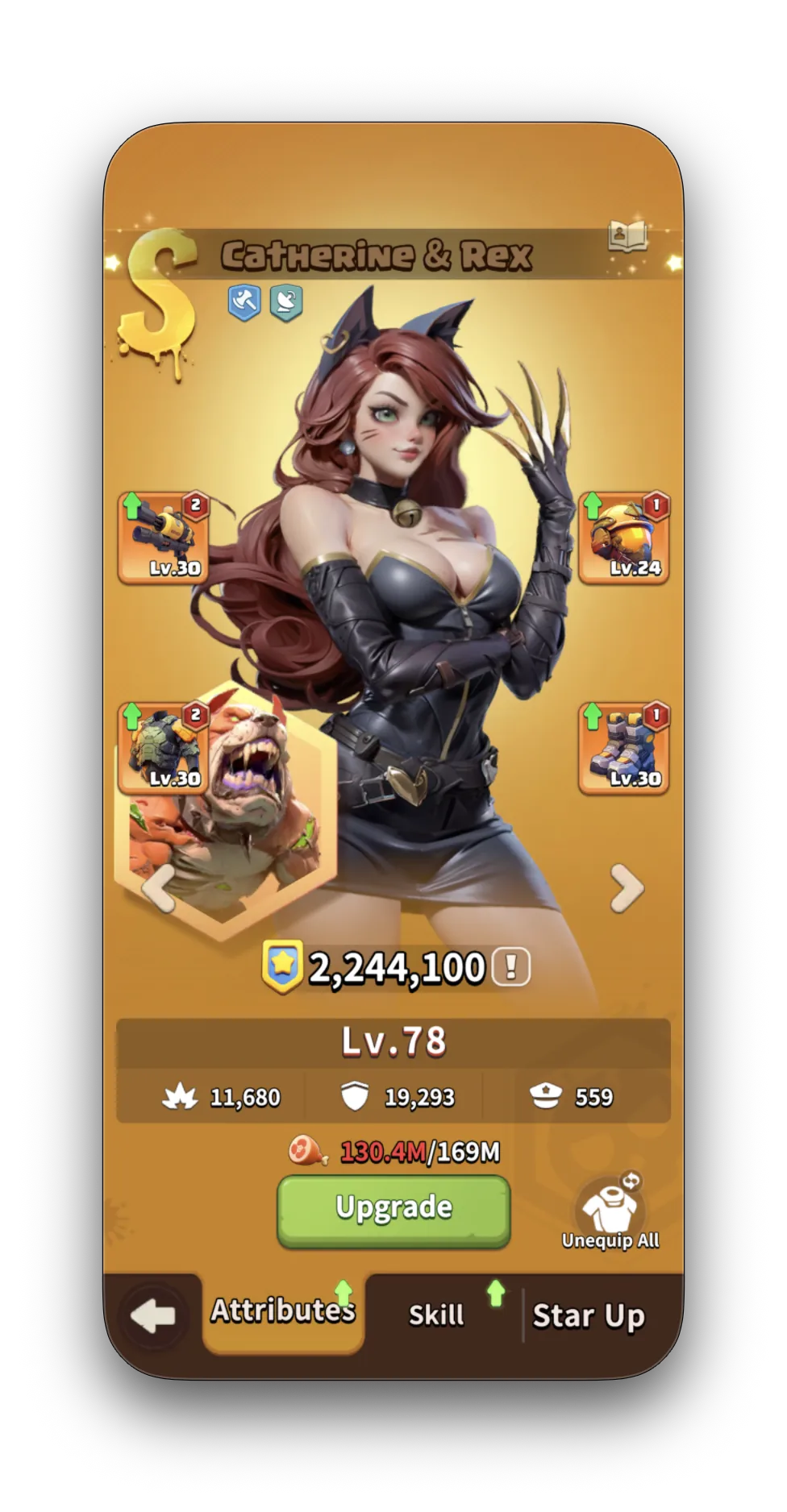
Catherine & Rex — S-tier Fighter Tank, Lv.78, CP 2,244,100, DEF 19,293
Catherine & Rex — DEF 19,293
C

Catherine & Rex — Front-Row Anchor Tank

Fighter / Tank — CP 2,244,100 · ATK 11,680 · DEF 19,293 · Troop 559

Free via story progression. DEF 19,293 makes her the second-hardest wall after Francis. "Go Rex Go!" deals 2,000%+ damage despite being a tank. As a Fighter, she benefits directly from both Tristan's DEF passive and Francis's HP passive — the multiplicative core makes her tougher than her raw stats suggest.

M

Megan — Faction Counter Utility

Shooter / Tank — Dual Purpose

The one non-Fighter. Covers the Shooter faction gap — when you face Fighter-heavy enemies, she's your counter. Also boosts construction speed passively. One Shooter in a Fighter squad gives faction flexibility without diluting passive stacking.

The 5th Slot — More Fighters or a Weapon Carrier?

You've got 4 Fighters locked in: Tristan, Guy, Francis, Catherine & Rex. The faction bonus (3+ same = 15% ATK/DEF) is already active. A 5th Fighter doesn't increase it. So the 5th slot is purely about what that individual hero adds to the formation.

The instinct is to go all-Fighter — Farhad at 4★ fills the slot, benefits from Tristan and Francis passives, keeps the roster "clean." But instinct isn't math.

Natasha — Shooter, Lv.77, CP 1,927,750, ATK 10,163 / DEF 10,326 / Troop 450
Natasha — CP 1.93M, 3★

Option A: Farhad (5th Fighter, 4★)

CP 1,574,800. As a Fighter, he benefits from Tristan's +30% DEF and Francis's +14.5% HP personally. His effective hero survivability:

1,574,800 × 1.30 × 1.145 ≈ 2,343,000 effective CP

Solid. But he brings no army-wide multiplier. His value is his own combat stats, buffed by faction passives. That's it.

Blood Rose — Natasha's Exclusive Weapon, CP 739,400, Faction Counter +4.60%, Troop DMG +4.60%, Troop HP +4.60%
Blood Rose — the team-wide multiplier

Option B: Natasha + Blood Rose (Shooter with Exclusive Weapon)

CP 1,927,750 — 23% higher base than Farhad. She doesn't benefit from Tristan/Francis passives (she's Shooter), so her effective hero CP stays at 1,927,750 raw. But look at what Blood Rose brings to the table:

Blood Rose (Exclusive Weapon)

Troop DMG +4.60% · Troop HP +4.60% · Faction Counter +4.60%

At 4★ Exclusive Talent "High Morale": Hero ATK +10%, DEF +10%, Troop Capacity +5%

Those "Troop" bonuses don't say "Shooter Troop." They say Troop — meaning your entire Fighter army benefits. Every single Spec Ops Fighter hits 4.6% harder and survives 4.6% longer. Combined: 1.046 × 1.046 = 9.4% more effective power across your whole army.

The Math That Decides It

With 18,000+ Spec Ops Fighters, a 9.4% army-wide multiplier is enormous. Let's compare what each hero actually contributes to total formation power:

Factor Farhad (5 Fighters) Natasha + Blood Rose
Faction Bonus 15% (3+ already met) 15% (4 Fighters still qualifies)
Troop Passives Unchanged — troops are Fighters Unchanged — troops are Fighters
Hero Effective CP ~2.34M (with passive boost) ~1.93M (no passive boost)
Army-Wide Multiplier None +4.6% DMG, +4.6% HP, +4.6% Counter
Troop Capacity Base +5% at 4★
Active Skill A-tier ceiling Crushing Kiss — 1,512% ATK
Future Optionality None Shooter passive ready for diversification

Farhad's advantage is ~410K effective hero CP from faction passive buffs. Natasha's advantage is a 9.4% multiplicative boost to your entire army. When your army is 18,000+ troops, the army-wide multiplier wins by an order of magnitude.

The Verdict

Natasha + Blood Rose. The 5th slot isn't about faction purity — it's about what adds the most total formation power. An exclusive weapon with team-wide Troop DMG and Troop HP multiplies your entire Fighter army. Farhad only multiplies himself. And when you eventually diversify into Shooters post-WT30, Natasha's passive (Shooters' DEF +15%, Shooter ATK up to +35%, All Shooters' battle damage +10%) activates across your new troops for free. She's an investment that appreciates.

The principle at work again: You're not picking a hero. You're picking a multiplier. Farhad is a personal multiplier — he benefits from passives himself. Natasha is a team multiplier — she pushes Blood Rose's bonuses onto your entire army. The same logic that says "pick Tristan for his army-wide DEF passive" says "pick Natasha for her army-wide weapon bonuses." Individual stats matter less than systemic reach.

Applying This to Your Faction

The Fighter example above is CerealKiller's application of this framework — not the only valid one. If you're building Riders or Shooters, the principle is identical. Every faction has its own multiplicative pair: a DEF booster and an HP booster whose passives compound army-wide. Every faction also has exclusive weapons that provide Troop DMG and Troop HP bonuses to your entire army. The game designs it this way deliberately (more on that in the Monetisation Design section below).

Here's how to find your faction's equivalent structure:

Step 1

Find your faction's DEF booster. Open each hero's passive skills and look for "all [faction] DEF" bonuses. That hero is your Tristan-equivalent — the one who makes your entire army take less damage per hit. Build them first. For CK's Fighters, this was Tristan at +30% DEF.

Step 2

Find your faction's HP booster. Look for "all [faction] HP" passives. That's your Francis-equivalent — they make your army survive more total hits. Together with the DEF booster, they form your multiplicative core. CK's was Francis at +14.5% HP. Together: 1.30 × 1.145 = 49% more effective survivability.

Step 3

Fill remaining slots with faction heroes + one off-faction weapon carrier. You need 3+ same-faction heroes for the 15% faction ATK/DEF bonus. Beyond that, consider whether a 5th faction hero adds more than an off-faction hero carrying an exclusive weapon with team-wide Troop DMG and Troop HP (see the Natasha analysis above — the principle is the same for any faction's weapon carrier).

Step 4

Check exclusive weapon stats carefully. Look for bonuses labelled "Troop DMG" and "Troop HP" — not "Fighter DMG" or "Shooter HP." The generic "Troop" label means the bonus applies to your entire army regardless of faction. These weapons are where off-faction heroes earn their slot.

If you're building Riders, your Tristan-equivalent is whichever Rider hero has an army-wide DEF passive. Your Francis-equivalent is the one with Rider HP. Your off-faction weapon carrier might be a Fighter or Shooter with a strong exclusive weapon — apply the same math CK used for the Farhad vs Natasha comparison above. The numbers will differ. The reasoning doesn't.

A quick way to evaluate your pair: Multiply the DEF passive by the HP passive (e.g., 1.30 × 1.145 = 1.49). CK considers anything above 1.35 (35%+ effective survivability) a strong multiplicative core. Below 1.20, it's worth checking whether your faction has a better option you haven't considered. Your threshold may differ depending on what other buff sources you have access to.

Recognise the Monetisation Design

This isn't a coincidence. Every faction has its own multiplicative pair and exclusive weapons because the game wants you to build all three. Three factions × hero fragments × exclusive weapons × research trees = triple the spending. It's elegant design — each faction's passives genuinely work, which makes the "balanced" approach feel rational even when it's the most expensive path.

For whales or high spenders with the luxury of going all-in on everything — knock yourself out, balanced works when money isn't the constraint. But for C2P players, the discipline is choosing one faction and staying there. Not just pre-WT30 — even after. The cost to build a second faction's hero passives, exclusive weapons, and research tree to competitive depth is effectively starting over. Your dollars compound deepest when they compound in one place.

The game tests whether you can resist the design that's specifically engineered to spread your spending thin. Same test as the countdown timer, the FOMO event, the sick dog. Different lever, same principle. Concentration is the counter.

Farhad — A-tier hero, Lv.78, CP 1,574,800
Farhad — A-tier, Lv.78

S-Tier vs A-Tier — The Ceiling Gap

Farhad (A-tier, CP 1,574,800) is solid. But at Lv.78 with full investment, he's at 1.57M CP. Guy at the same level is nearly double at 3.09M. That's not a skill gap — it's a ceiling gap baked into base stats.

Use A-tier heroes for gathering, APC slot filling, and faction coverage. But premium fragments always go to your multiplicative core and S-tier supports. The ceiling gap compounds over time — the earlier you concentrate, the further ahead you pull.

Guy's Honor Level panel — Faction: Fighter, CP 45,000, Boost all heroes' ATK: 100, plus Fighter ATK troop buffs
Honor Level — global troop buffs

Honor Level — Yet Another Multiplicative Layer

Once a hero reaches Hall of Honor (5-star), Honor Level unlocks global troop buffs for your entire army. Guy's Honor Level adds +100 ATK to all heroes and stacks Fighter ATK bonuses across tiers. This is another compound layer — concentrated investment unlocks buffs that amplify everything else you've built.

This system is invisible to new players. It's the reason a veteran with 3 maxed heroes outperforms someone with 8 half-built ones — honor buffs silently multiply every battle, on top of passive stacking.

The Equipment Surprise — It's Pooled in Troop Battles

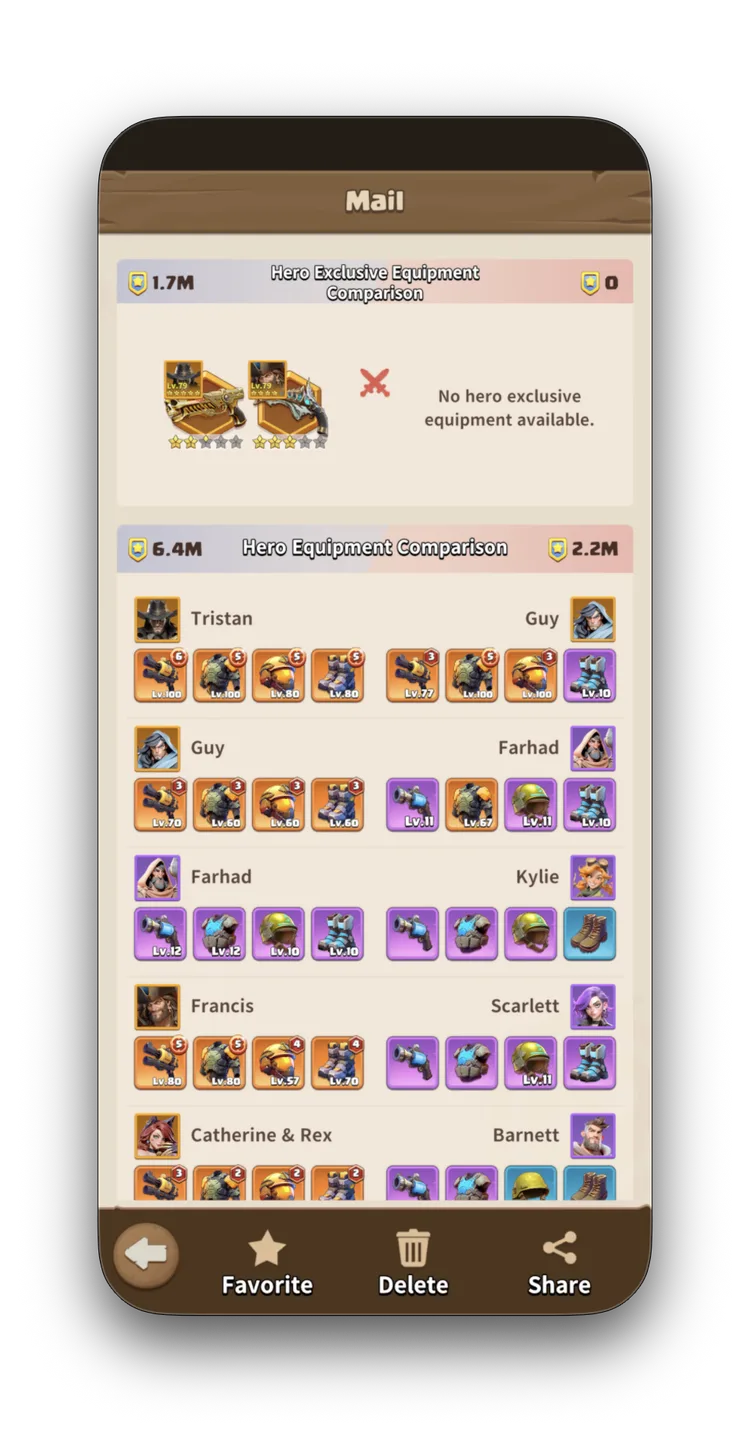
Hero Equipment Comparison — CK has all heroes fully equipped, NKS has minimal gear. Result: 128.5% vs 57.3% in Troop Buffs.
CK fully equipped vs NKS barely — the pooled number tells the story

Here's something most hero guides don't mention: in troop battles (PvP, rallies, world map), hero equipment is pooled into one number. The game sums all equipment across all your APC heroes and applies the total as a single buff. It doesn't matter which hero wears which piece — the troop damage is the same.

This means stop agonising over gear allocation for PvP. Instead, focus on total equipment quality across all heroes. The battle systems page shows the proof — CK's Hero Equipment contributes 122.3% as one pooled percentage.

In hero battles (Adventure/PvE), allocation does matter for normal attacks — ATK gear on Strikers, DEF gear on Tankers. But for the fights that decide wars, it's the total that counts.

CerealKiller's hero roster page 2
Full roster — page 2

How to Think About Investment

✓ Multiplicative core first

Find your faction's DEF + HP passive pair. If you're following a concentration strategy, fragments and skill books go to these heroes first. This one decision shapes everything downstream.

✗ New-gen heroes are expensive for C2P

Ryan, Shadow, Angela — star-up cost is enormous without heavy spending. For most C2P players, a 5-star core hero with army-wide passives outperforms a 1-star anything. If you're spending at whale level, the calculus changes — new-gen heroes may be worth pursuing directly.

✓ Passive roles for the rest

Non-combat heroes earn value on gathering, construction, and research without needing fragments. Also: get unused heroes to Lv.40/4★ for their free global buff — it feeds the shared pool in hero battles.

✗ Fragment spreading has a compounding cost

In a multiplicative system, every fragment on a non-core hero is a fragment not deepening your multiplicative engine. The earlier you concentrate, the further the compounding advantage pulls ahead. This is especially true for C2P and F2P players — if you're a heavy spender, you may have the resources to invest more broadly.

When This Framework Doesn't Apply

Different situation

Heavy spenders building all three factions. If money isn't the constraint, balanced hero investment across Fighters, Riders, and Shooters is viable. The multiplicative core principle still applies — you'd just build three separate cores instead of one.

Different situation

Arena/Duel specialists. Competitive PvP formats reward counter-drafting. A single-faction hero roster is predictable. If Arena ranking is your primary goal, you'll need broader hero coverage than this guide recommends.

Different situation

Late-server players joining established meta. If your server is deep into Season 4+ and multi-faction armies are the norm, concentrating on one faction's heroes may not give you the alliance utility your team needs. Adapt to your server's reality.

Different situation

Players who value variety over optimisation. This framework optimises for power per resource spent. If you enjoy collecting and building diverse heroes because it's fun, that's a legitimate way to play — the math just won't compound as fast.